Monday, March 28, 2011

artist 3/28 Blake Ogden


Blake Ogden


I really enjoy Blake Ogdens work for many reasons. First off I really love the nostalgic feel that it creates when you are looking at his images. I also love the personification in some of the images that is created with the objects that he photographs. These images create somewhat of a narrative within the work that makes you wonder what the story is behind these objects. Ogden builds a relationship between the objects, himself, and the viewer that is unique.

Ogden's been in many solo exhibitions and publications. Some of which include The Photo Review  in 2001 and 2000, Plates to Pixels Magazine   in 2009, and Intimate History in 2009 to name a few.

The reflection on the past is what really draws me to Ogdens work however. I feel that in theme it may be similar to my own work this semester. Also the way he shows relationship between the dolls in two of the pictures is similar to the concept of relationship within my own work.

"I prefer to work with film. My black and white work is printed conventionally in a chemical darkroom, while my color work is scanned from film and then out put as digital pigment prints."


Thursday, March 24, 2011

3/24 Show Entry

I entered 3 pieces into the Anderson Gallery show. These are my images that I submitted.


And here are my entry receipts:


idea 3/24 self portraiture

Self portraiture.

What is the purpose behind an artist putting their physicality inside of their work? What does that accomplish? And how does that effect the viewer?

There is something that begins to happen within ones work when they chose themselves as the subject matter. That happening is both different to the viewer and the artist, but both still have a unique experience. There is something interesting that appears within an image when it is just me and the camera alone in the room. A vulnerability that would not have shown through had a third person been brought in. We get comfortable. We are no longer thinking about what someone is going to think when they see this image and start to interact with the camera in a much more intimate way.

This effects the viewer too. A connection is made between subject and audience that is not usually made when the equation is a photographer + camera + model. You begin to sense that you are witnessing something that you were never meant to see. It's better than acting and better than modeling because the sense of being watched is not there and therefore there is no acknowledgement of the camera. This was essential to my work. So much that I had to ban anyone from entering or even being near my shoots, so that I could produce the most authentic sense of the situation that was being recorded. There is no acknowledgement of the camera in my images, no direct connection with the viewer. Not even through body language.

But who really benefits from this? The artist or the viewer? Or both? There is a moment of total freedom within the span of time that you are capturing yourself on film,  on paper, etc. You stop acting and just become the part, the moment that is playing out before you. So again I ask, to whose benefit is this?

"A self-portrait is a representation of an artist, drawn, painted, photographed, or sculpted by the artist. Although self-portraits have been made by artists since the earliest times, it is not until the Early Renaissance in the mid 15th century that artists can be frequently identified depicting themselves as either the main subject, or as important characters in their work."

wikipedia. http://en.wikipedia.org/wiki/Self-portrait. web.

Monday, March 21, 2011

Artist 3/21 - Cindy Sherman


Cindy Sherman

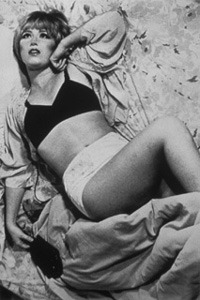
Cindy Sherman is a New York based photographer born in 1954. She studied at Buffalo State College, originally interested in painting but continued on her work through film and photography. Sherman's main subject matter is herself. She creates self portraits portraying different personas and assumed roles. Many would try to label her work as feminist, though she would not.

I am incredibly drawn to the work of Cindy Sherman because of her basic principles of self portraiture. I've realized that my work has many parallels to hers. She also uses herself as the only model and acts out roles to be portrayed in her images. One main difference between our works is that my situations are not fabricated, and along with acting out other personas I also often portray myself within the images. I find Cindy Sherman to be a great inspiration to my work, though our motives in creation and production style are different. There is something to be said about the repetition of the same face and the acting out of a character in front of a camera that tends to draw a viewer in. It stops being documentary and begins to be something more. Something alive.

"When I moved to New York, in the summer of ’77, I was trying to think of a new way to take pictures and tell a story. David Salle had been working at some sleazy magazine company where they had lots of shots of half-clothed women around, for those photo-novellas, like a cartoon but with photos. Slightly racy. It got me thinking, this cheap, throwaway image—if you just look at one, you make up your own story. "

Stevens, Mark. New York. http://nymag.com/anniversary/40th/culture/45773/. 2008. Web.

"It was exactly like that. I did try using family members or friends, and once I paid an assistant. But even when I was paying somebody, I still wanted to rush through and get them out of the studio. I felt like I was imposing on them. Also, I got the feeling that they were having fun, to a certain extent, thinking this was like Halloween, or playing dress-up. The levels I try to get to are not about the having-fun part. I also realised that I myself don't know exactly what I want from a picture, so it's hard to articulate that to somebody else - anybody else. When I'm doing it myself, I'm really just using the mirror to summon something I don't even know until I see it. "

Berne, Betsy. TATE Magazine. http://www.tate.org.uk/magazine/issue5/sherman.htm. Web.

Gagosian Gallery:

Thursday, March 17, 2011

idea 3/17 Duplicate

Duplicate: noun 1. A copy exactly like an original
                verb  1. To make an exact copy of
                         2.  To do or perform again. Repeat.

Duplication has been a big part of my series this semester. Infact is has almost engulfed the series entirely. The whole series revolves on the idea that I am duplicating myself as I act out several roles of myself and others. So what does this do to the viewer? This repetition begins to register in the mind of the audience before they even realize that I am the only subject matter. As long as my work is successful, it will not be an obvious first sight to see that the only subject in the images are myself, which makes the duplication that much more important. Once the viewer begins to see that there is one subject duplicated over and over they begin to question the motives of the image. Who is that person? Why are they in seperate roles? Which role is the focal point? And which role is actually her (if any)?

I've always found it important to make the viewer ask questions. If they have no questions then they have no reason to continue on with your work.

I also find it important for the viewer to not know 100% which subject is the main subject. Which one are they following throughout the series? This way they can kind of pick which area they most relate with without being told where to go or what to think within the series.